A crowded closet makes every morning a little harder. You know the feeling: a rod full of clothes and nothing to wear. Good closet organization is not about owning less for the sake of it. It is about seeing what you have, keeping what you love, and making it easy to get dressed. This is the step-by-step closet edit I use with clients across the Austin area, and you can start it this weekend.
Before You Start: Set Yourself Up
Give yourself a block of time, usually two to four hours for a standard reach-in closet and longer for a walk-in. Gather a few supplies before you begin:
- Three large bags or boxes marked Donate, Sell and Tailor or Repair
- A trash bag
- A full-length mirror nearby
- A clear spot on the bed or floor to sort
Put on music or a podcast. This should feel like a project, not a punishment.
Step 1: Empty the Closet One Section at a Time
For most people, pulling out everything at once is overwhelming. Instead, work in sections: hanging tops, then pants, then dresses, then shoes, then the shelf above. Emptying a section completely lets you see the true volume of each category, and it gives you a chance to wipe down shelves and vacuum the floor.
Step 2: The Closet Edit – Deciding What Stays
Hold each item and ask a few simple questions:
- Have I worn this in the last year?
- Does it fit the body I have right now?
- Do I feel good when I wear it?
- If I saw it in a store today, would I buy it?
If the answers are mostly no, it is probably ready for a new home. You are always the one making the call. When I work with clients, I never decide for anyone what they keep. My job is to ask good questions and keep things moving.
A few categories deserve special attention in Texas. Heavy winter coats and sweaters get very little use here, so keep your favorites and let the rest go. Seasonal items can move to the top shelf or an under-bed bin so your prime space holds what you wear most of the year.
Sentimental pieces are allowed. If something matters to you, keep it, but consider storing it in a labeled keepsake box rather than letting it take up daily hanging space.
Step 3: Organize the Closet by Category and Color
Once your keep pile is final, put things back with intention:
- Use matching hangers. Slim, uniform hangers can free up a surprising amount of rod space and make the closet look calm.
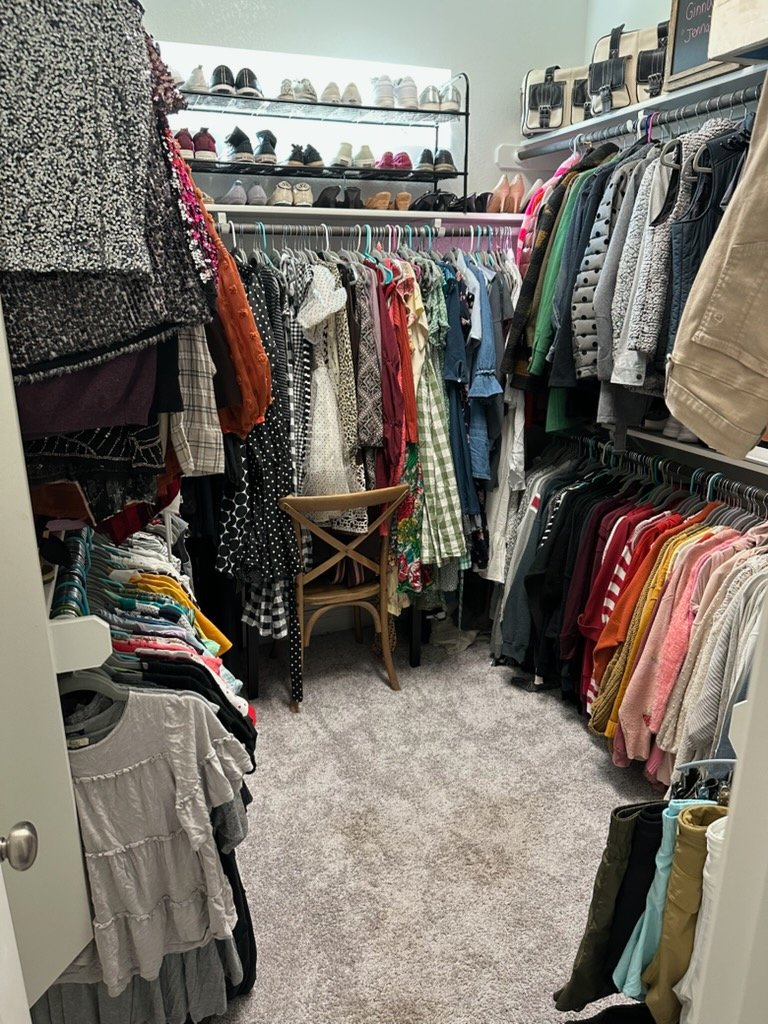
- Group by type, then by color. All short-sleeve tops together, then long-sleeve, then sweaters. Within each group, go light to dark. You will see at a glance what you own.
- Put daily items at arm's reach. Work clothes and everyday favorites belong in the middle of the rod, not the far corner.
- Fold what stretches. Knits and heavy sweaters hold their shape better on a shelf. Shelf dividers keep folded stacks from toppling.
- Contain the small stuff. Belts, scarves and bags do well in clear bins or on over-door racks. Drawer dividers make socks and undergarments easy to find.
- Give shoes a clear system. Shoe shelves or clear boxes, with the pairs you wear most at the lowest, easiest level.
Color-coding sounds fussy, but it helps. One client who was downsizing into a smaller home put it this way:
"She managed to make everything fit, super neatly, organized, color coded, everything visible and easy to reach." – Katrina G.
Visible and easy to reach is the whole point. You can browse finished closets in my before and after gallery for ideas.
Step 4: Keep Your Closet Organized With Small Habits
The edit gets you to a fresh start. These habits keep you there:
- One in, one out. When a new piece comes home, choose one to let go.
- Keep a donate bag in the closet. When you try something on and it does not work, it goes straight into the bag.
- Turn hangers backward. At the start of a season, face every hanger the same way. After you wear something, hang it back the normal way. In six months, you will see what you never reached for.
- Do a quick seasonal swap. Twice a year, in spring and fall, rotate stored items and do a mini edit.
If your closet feels like too much to face alone, you are not the only one. I help clients in Austin, Round Rock, Cedar Park, Leander, Pflugerville and Manor with closets of every size, from small reach-ins to shared primary closets. Learn more about my organizing services.
If you would rather have a hand with this, I would love to help. Book a free consultation or call or text me at 737-376-1599, and we can talk through your space and what would make it work for you.